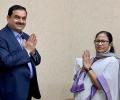
The words 'industry', 'industrial development', 'jobs', and 'employment' have been ringing with higher frequency since Mamata Banerjee stepped into her third term with landslide victory after a high-octane election last year. "Our government's next target is industrial development," the chief minister (CM) had been heard stating at different public meetings in the past few months - perhaps setting the tone for the sixth edition of the Bengal Global Business Summit (BGBS) slated for later this month. Investor summits by any state are about intent, big numbers, and tall claims. Yet in competitive federalism, its importance as a marketing tool is undeniable.
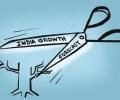
India's projected economic growth for 2022 has been downgraded by over two per cent to 4.6% by the United Nations, a decrease attributed to the ongoing war in Ukraine, with New Delhi expected to face restraints on energy access and prices, reflexes from trade sanctions, food inflation, tightening policies and financial instability, according to a UN report released on Thursday. The UN Conference on Trade and Development (UNCTAD) report downgraded its global economic growth projection for 2022 to 2.6 per cent from 3.6 per cent due to shocks from the Ukraine war and changes in macroeconomic policies that put developing countries particularly at risk. The report said while Russia will experience a deep recession this year, significant slowdowns in growth are expected in parts of Western Europe and Central, South and South-East Asia.
Days after the government went public with its intent to examine a Sebi order in the NSE matter, its outgoing chairman Ajay Tyagi on Wednesday made it clear that the markets regulator did not "dilute" any of the quasi-judicial verdicts. The comments assume significance as they come after Finance Minister Nirmala Sitharaman, as per reports, recently said the government is examining if Sebi has taken "necessary punitive" action in the case. In a media interview, the FM had said the government was analysing if there had been "enough application of mind in dealing with this" and if after applying its mind, Sebi took adequate corrective steps.

How Amul is changing the face of dairying in Jammu & Kashmir. Some 15,000 dairy farmers, many women, are participating in the initiative.

The poll released on Tuesday found a global average of 46 per cent interest in the Games, but excitement varied across markets

'Modi had not discussed demonetization with me prior to his announcement on 8 November 2016. 'I learnt of it along with the rest of the country. 'I was not surprised when he did not discuss the issue with me prior to making the public announcement. 'It fitted in with his style of making dramatic announcements.' A fascinating excerpt from Pranab Mukherjee's The Presidential Years: 2012-2017.

The ED case of money laundering in the excise policy stems from a CBI FIR in which Delhi Deputy Chief Minister Manish Sisodia and some bureaucrats have been named as accused. The excise policy has been rolled back now.

Automobile retail sales in India increased by 37 per cent in April on a low base of COVID-hit April last year, automobile dealers' body FADA said on Thursday. Total sales across categories rose to 16,27,975 units in April, as compared to 11,87,771 units in the year-ago period. On a year-on-year basis, all vehicle categories including passenger vehicles and two-wheelers were up as compared with April last year.

The Modi government's defeat on farm laws underlines the perils of governing an entire continent-sized, diverse and federal nation like the chief minister of a state, observes Shekhar Gupta.
Sensex ended up 11 points at 25,561 and the 50-share Nifty gained 16 points to end at 7,640.

HDFC was the top loser in the Sensex pack, shedding over 2 per cent, followed by Axis Bank, Bharti Airtel, M&M, Reliance Industries, ICICI Bank, IndusInd Bank and Titan.
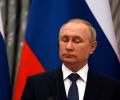
These sweeping financial sanctions follow the action earlier this week to cut off Russia's frozen funds in the United States to make debt payments.

Vipul Chaudhary, chairman of Gujarat Cooperative Milk Marketing Federation (GCMMF) that markets its products under the Amul brand, has been removed from the post.

UN Secretary General Antonio Guterres has termed Russian President Vladimir Putin announcement of a special military operation in Ukraine as the "saddest moment in my tenure", while Security Council members blasted the Russian leader for the "unprovoked and unjustified' action and for delivering a "message of war".

India-born US district judge Amit Mehta, an Obama appointee, has been assigned the justice department's crucial lawsuit against internet search giant Google.

Although the current long-term bullish trend is intact, markets are awaiting clarity on the taper and the Assembly election results.
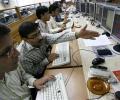
Meanwhile, IT index continues to be the top loser down 3.8%. Financial stocks witnessed renewed buying interest at lower levels.

The DMK feels its genuine gestures have had no bearing on the governor's politico-administrative conduct, which is 'more political and politicised than administrative and Constitutional', observes N Sathiya Moorthy.

Social media giant accused of anti-competitive conduct by abusing its market power to create a monopoly and crushing smaller competitors.

After outperforming the broader market and their public sector peers for the better part of the post-Lehman period, private sector banks - such as HDFC Bank, ICICI Bank, Axis Bank, and Kotak Mahindra Bank - are now underperforming. Last week, the Nifty Private Bank index was up just 6 per cent year-to-date in the calendar year 2021, against nearly 13 per cent rally in the Bank Nifty and a 15 per cent rise in the benchmark Nifty50. Public sector (PSU) banks, such as State bank of India, Bank of Baroda, and Punjab National Bank, are now rally leaders and outperforming the broader market. The Nifty PSU Bank index was up 42 per cent since the beginning of this calendar year. But on a longer term, the Nifty Private Bank index is up 101 per cent since March 2016, against a 118 per cent rally in the Bank Nifty and just 2 per cent rise in the Nifty PSU Bank index in the period.

Hitting out at Prime Minister Narendra Modi over the issue of tax cuts on petroleum products, Tamil Nadu Chief Minister M K Stalin on Thursday said people were aware of the fact behind the issue and pointed out at his government effecting a Rs 3 a litre cut on petrol earlier.
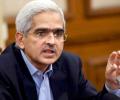
The increasing involvement of Big Tech in the financial system could give rise to concentration risk and there are potential spillovers, which call for closer attention, Reserve Bank of India (RBI) Governor Shaktikanta Das said on Tuesday. "...enormous amounts of consumer data is being generated and leveraged upon by a few entities (the so-called Big Tech) by virtue of their huge customer base. "Such developments raise concerns on concentration risk and potential spillovers as their level of engagement with the financial system strengthens in the years to come," Das said at the Global Fintech Fest 2022.

Speaking to reporters in Bengaluru on the sidelines of the Eighth National Conference on Krishi Vigyan Kendras 2013, Pawar also ruled out the possibility of traders exporting onions to other countries where prices are less than India.
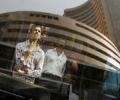
The 30-share Sensex ended down 215 points at 27,011.

When there is panic, you get an opportunity to get your hands on some of the good stocks.

Nearly 40% of the annual sales happen during April to June.
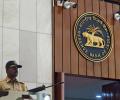
Striking a different note from its peers, US brokerage Bank of America Securities has maintained that the Reserve Bank will leave rates unchanged next week, recognising growth-focused and capex-driven fiscal expansion, which though poses huge price pressure and interest rate risks later. The RBI's rate setting panel Monetary Policy Committee (MPC) will begin its deliberations next Monday and announce the policy moves on Wednesday (February 9) in the backdrop of a massive spike in bond yields post the Budget. Almost all major central banks are in the process of hiking rates to tame inflation.

Markets in green tracking firm global cues.

Sensex eneded lower on poor perfromance by financials and IT stocks.

Fourteen of 17 board members move no-confidence motion; proximity to Rahul Gandhi seen as trigger.

Yellen, 74, was confirmed by the Senate in a broad bipartisan support of 84-15 votes on Monday. Both the Democratic and the Republican parties have 50 members in the 100-seat Senate.
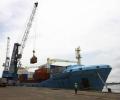
As many as 26 premises are being searched in these cities by the federal agency under the criminal sections of the Prevention of Money Laundering Act, they said.

Trade sanctions on Russia by Europe and the US offer an opportunity for India, but the devaluation of the rouble may play spoilsport

Even as the gaming industry battles multiple regulations in different Indian states, it has received more than double the amount of investment this year compared to 2020. Industry watchers attribute this to the growing popularity of gaming, spurred by the pandemic, and the innovative business models gaming firms have built. According to data from industry tracker Venture Intelligence, investment in India's gaming sector in 2021 has more than doubled to $794 million, as against a total investment of $339 million last year. In 2019, this number was $176 million. Marquee investors such as Tiger Global (Dream11), Sequoia Capital India (Mobile Premier League), WinZO (Griffin Capital Partners), Tencent (Dream11) and Matrix Partners (Zupee) have pumped money into the sector.
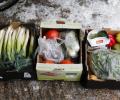
Centre has already started work on developing a mechanism to ensure states producing any item in excess is able to transport it to other states where there is demand

News of all that's transpired on and off the football field

If the government had paid enough to begin with, or if it had made serious advance purchase commitments that allowed the vaccine producers to mobilise necessary investment, then it is possible to imagine more free or subsidised vaccines such as are available in developed economies, asserts Mihir S Sharma.
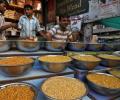
Over all trends indicate prices of pulses and onions have declined, and prices of all other commodities have remained stable across the country.

The market could be influenced by events elsewhere in the world and regardless of what happens to India's economy
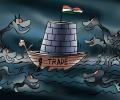
With Kabul falling into the hands of the Taliban, bilateral trade between Afghanistan and India will get impacted significantly in these uncertain times, according to exporters. Federation of Indian Export Organisations (FIEO) director general Ajay Sahai said domestic exporters should follow caution looking into the political development in Afghanistan, particularly with regard to payments, for which adequate credit insurance may be availed by them. "The trade will be impacted. It would reduce due to the growing uncertainty in Afghanistan," he said on Monday. Former FIEO president and country's leading exporter S K Saraf too said there will be a significant fall in the bilateral trade.
 © 2026 Rediff.com - Advertise with us - Disclaimer - Privacy Policy - Sitemap - Feedback - About us - Terms of use - Grievances